Prevent Muscle Loss: Discover the Power of HMB (Beta-Hydroxy-Beta-Methylbutyrate)
“What Is HMB?”
A curious patient once asked me this question.
Suzie* had been receiving a supplement often used in hospitals that contains HMB as part of her recovery plan for pressure wounds/bed sores that developed after spending too long in bed without repositioning.
“HMB helps your body heal wounds and prevents more muscle breakdown—especially since you’re not moving around much,” I explained. “We want you to stay as strong as possible!”
Most of my friends, family, and patients know I don’t recommend supplements lightly. There are plenty of “miracle” products out there that waste people’s time and money. Modern day snake oils. In a world where even a carton of eggs can feel expensive, I only recommend supplements that we have good reason to believe are likely to help —especially when someone is already struggling to afford nutritious food.
What Is HMB?
HMB (Beta-Hydroxy-Beta-Methylbutyrate) is a natural compound your body makes when it breaks down leucine, an essential amino acid.
Because leucine is an essential amino acid - meaning you must get it from food—your body can’t make it on its own. Great sources of leucine include:
Meat, poultry, and fish
Eggs and dairy (like cottage cheese)
Beans, lentils, and seeds
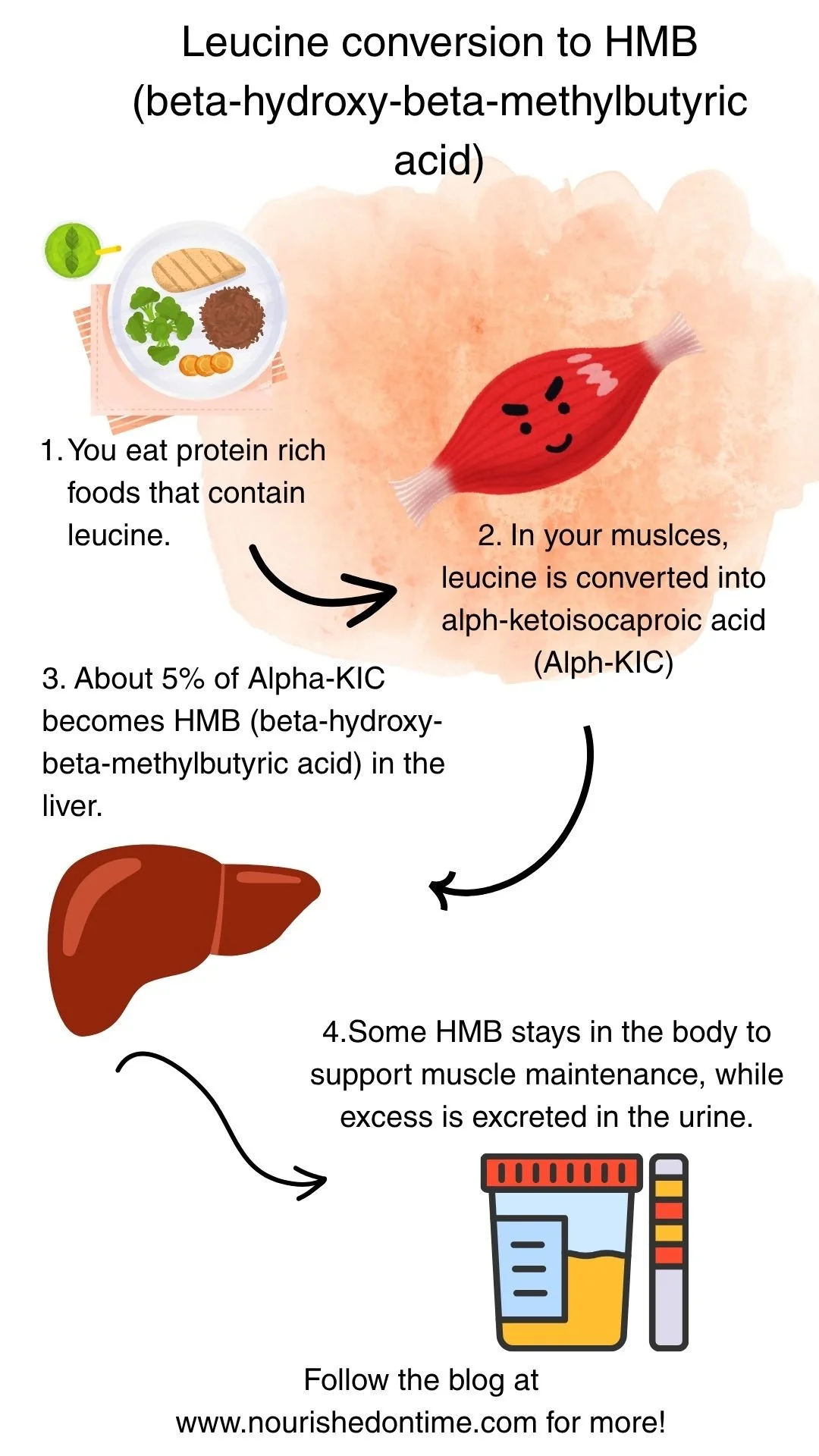
Process of conversion from protein to HMB(5):
You eat protein-rich foods that contain leucine.
In your muscles, leucine converts into alpha-ketoisocaproic acid (alpha-KIC).
About 5% of alpha-KIC becomes HMB in the liver.
Some HMB stays in the body to support muscle maintenance, while excess is excreted in the urine.
What Is HMB Good For?
HMB has been studied for over 30 years, mainly for its role in preserving muscle mass and supporting recovery when movement or protein intake is limited.
In addition to eating adequate amounts of calories, protein, and maintaining Vitamin D levels, research suggests HMB may:
Preserve muscle in people with cancer or chronic illness who are at risk for muscle wasting1.
Reduce inflammation and muscle loss in cases of inactivity or protein deficiency4.
Potentially influence cholesterol metabolism, though findings are mixed5.
In combination with arginine and glutamine (amino acids), it may shorten the healing time of pressure injuries/bed sores - especially for older, bedridden individuals6.
Improving recovery from surgery by reducing complications and reducing the length of stay in the hospital7.
What Is HMB Not Good For?
HMB is not a shortcut to strength or fitness. The evidence does not support using HMB for muscle growth or weight gain. For healthy adults who exercise regularly, studies show that HMB alone does not significantly enhance muscle size or performance2,5.
If your goal is to build strength, muscle, or gain weight, focus on:
Eating enough high-quality protein and adequate calories throughout the day.
Strength training several times per week.
Getting adequate sleep and rest.
These steps may sound simple, but can be difficult depending on your situation. It may be worth talking to a dietitian 1 on 1 to see how to make changes that will slowly get you to your goals.
What’s an Effective Dose—and What Should You Look For?
There are two primary forms of HMB available:
HMB-CA (calcium salt) – the most common and well-researched.
HMB-FA (free acid) – a newer form that might be more easily absorbed (the verdict is still out).
Most studies suggest that 1.5 to 3 grams of HMB per day is both safe and effective when taken consistently3.
It remains unclear if HMB – CA or HMB – FA is more bioavailable. HMB can be found in many forms - liquid, gel, capsule, soft gel. The form of supplementation may also impact absorption. More studies need to be done in this area as it is unclear which form is most impactful.
Tips when buying HMB:
Choose products with third-party testing to ensure the product is providing the ingredients it specifies on the label and not utilizing other fillers or components not on the label. Two well-established third party organizations are USP or NSF.
Check labels for HMB-CA or HMB-FA content and directions for use – aim for between 1.5 and 3 grams of HMB/day.
Are There Any Side Effects?
HMB is considered safe and well-tolerated, even at higher doses. Research shows no negative effects in adults taking up to 3 grams daily for at least one year (other than some minor stomach discomfort)3. However, supplements should always be viewed as part of a comprehensive nutrition plan, not a replacement for balanced eating. It is essential to eat adequate calories and protein to improve the possibility to maintain muscle and strength.
The Bottom Line
For adults who are temporarily unable to exercise—such as during recovery from illness, surgery, wounds, or hospitalization—HMB-CA or HMB-FA may help the healing process and maintain muscle strength when you might normally lose strength from not using your muscles. To maximize benefits, make sure you also: maintain adequate vitamin D levels, eat adequate protein and calories to prevent muscle loss and, follow your physicians instructions regarding exercise or rehab.
*Names and details have been changed to protect patient privacy.
This blog is meant for informational and educational purposes only. Please consult your personal healthcare team before starting any supplementation regimen.
References:
1. Prado, C. M., Orsso, C. E., Pereira, S. L., Atherton, P. J., & Deutz, N. E. (2022). Effects of β‐hydroxy β‐methylbutyrate (HMB) supplementation on muscle mass, function, and other outcomes in patients with cancer: a systematic review. Journal of cachexia, sarcopenia and muscle, 13(3), 1623-1641.
2. Osuka, Y., Kojima, N., Sasai, H., Wakaba, K., Miyauchi, D., Tanaka, K., & Kim, H. (2021). Effects of exercise and/or β-hydroxy-β-methylbutyrate supplementation on muscle mass, muscle strength, and physical performance in older women with low muscle mass: a randomized, double-blind, placebo-controlled trial. The American Journal of Clinical Nutrition, 114(4), 1371-1385.
3. Rathmacher, J. A., Pitchford, L. M., Stout, J. R., Townsend, J. R., Jäger, R., Kreider, R. B., ... & Antonio, J. (2025). International society of sports nutrition position stand: β-hydroxy-β-methylbutyrate (HMB). Journal of the International Society of Sports Nutrition, 22(1), 2434734.
4. He, X., Li, Y., Chen, J., Huang, Y., Zhou, Y., Li, Y., & Quan, J. (2025). β-hydroxy-β-methylbutyrate supplementation mitigates muscle atrophy induced by inactivity and protein deprivation. Biogerontology, 26(4), 120.
5. Holeček, M. (2017). Beta‐hydroxy‐beta‐methylbutyrate supplementation and skeletal muscle in healthy and muscle‐wasting conditions. Journal of cachexia, sarcopenia and muscle, 8(4), 529-541.
6. Kisil, I., & Gimelfarb, Y. (2023). Long-term supplementation with a combination of beta-hydroxy-beta-methylbutyrate, arginine, and glutamine for pressure ulcer in sedentary older adults: a retrospective matched case-control study. Journal of Yeungnam medical science, 40(4), 364-372.
7. Hu, Y. G., Shi, J. H., Yu, D. X., & Huang, H. B. (2025). The effects of beta-hydroxy-beta-methyl butyrate supplementation in surgical patients: a systematic review and meta-analysis of randomized controlled trials. Frontiers in Nutrition, 12, 1621206.